Innovative Practices in STEM Education: Emerging Technologies, Pedagogies and Learning Models examines how contemporary pedagogical approaches and emerging technologies can be effectively integrated to design meaningful, equitable, and sustainable STEM learning environments. This edited volume moves beyond technology-driven innovation by emphasizing the critical role of theory-informed pedagogy, curriculum design, and assessment in advancing STEM education. Drawing on diverse frameworks such as inquiry- and problem-based learning, computational thinking, gamification, variation theory, integrative STEM, and TPACK, the book illustrates how innovative practices support deep conceptual understanding, creativity, and collaboration across STEM disciplines. Mathematics is positioned as a unifying discipline that connects science, technology, and engineering through modelling and problem solving. With a strong focus on implementation and equity, the volume presents international case studies and research-based examples from face-to-face, hybrid, and virtual contexts, including rural and underserved settings. By critically examining emerging technologies—such as augmented reality, metaverse environments, open-source platforms, and game-based learning—alongside STEAM, entrepreneurship, and community-based initiatives, the book offers a comprehensive and practice-oriented perspective. Intended for researchers, educators, and policymakers, this volume provides an evidence-informed roadmap for developing coherent, inclusive, and future-ready STEM education practices.
Innovative Practices in STEM Education: Emerging Technologies, Pedagogies and Learning Models
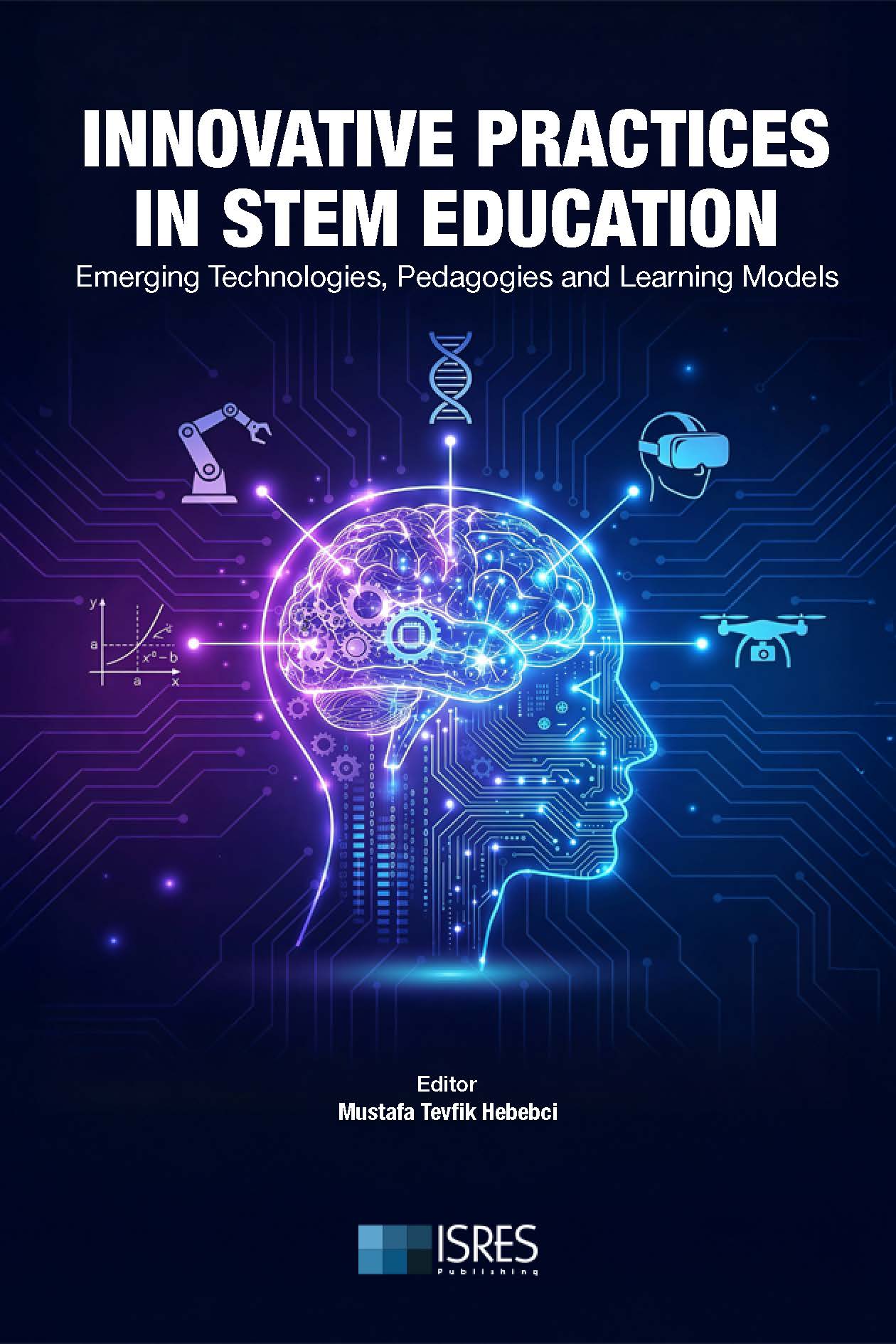
Innovative Practices in STEM Education: Emerging Technologies, Pedagogies and Learning Models
Editors: Mustafa Tevfik Hebebci
Table of Contents
Teaching Methods and Applications in STEM Education: From Theory to Practice
Selim Yavuz, Mustafa Tevfik Hebebci
More Info Pages: 1-30
Problem-Based Learning and Inquiry-Based STEM Education
Ümran Betül Cebesoy
More Info Pages: 31-52
Gamification Strategies in STEM Education
Nor K. H. B. Kamaruzaman, Kamisah Osman, Nurazidawati Binti Mohamad Arsad
More Info Pages: 53-84
Two Decades of Game-Based Learning Research in STEM Education
Irwanto Irwanto
More Info Pages: 85-122
Computational Thinking and STEM Education
Ebru Kükey
More Info Pages: 123-146
STEM, Metaverse and Augmented Reality
Nigmet Koklu, Suleyman Alpaslan Sulak
More Info Pages: 147-174
Open Source and Online Platforms in STEM Education
Nilay Muslu-Komurcu, Hasan Zuhtu Okulu
More Info Pages: 175-200
STEM and Arts Integration: STEAM Approach
Yasin Uzun
More Info Pages: 201-224
Innovation and Entrepreneurship Integration in STEM Education: eSTEM
Gizem Ozyazici
More Info Pages: 225-250
STEM Enrichment Through FSM: A Graduate-Led Summer Camp Model for Equitable Learning in Math and Science
Selim Yavuz, Hyunjeong Lee
More Info Pages: 251-280
From Curiosity to Discovery: Promoting Student STEM Research in Rural High Schools
Alisa Wickliff
More Info Pages: 281-299
Budapest/Hungary Conferences - August 28-31, 2025
We are pleased to invite you to ISRES conferences, which will be held at Obuda University/Budapest/Hungary on August, 28-31, 2025. The following conferences will be held in Budapest/Hungary:...
15.01.2025
Trabzon/Türkiye Conferences - May 01-04, 2025
ISRES Spring Conferences - Trabzon/Turkiye SOCIAL SCIENCES – May 1-4, 2025, Trabzon, Türkiye * 5th International Conference on Social Science Studies - IConSoS2025 ...
11.12.2024
Peja/Kosovo Conferences - July 10-13, 2025
We are pleased to invite you to our conferences, which will be held at University of Peja Haxhi Zeka on July, 10-13, 2025. The following conferences will be held in Peja/Kosovo: - 7th Internat...
28.11.2024
_Sayfa_001_23-12-2025.jpg)


 (1)_16-12-2024.jpg)


_29-12-2024.jpg)
 (1)_01-01-2025_10-03-2025.jpg)
_01-01-2025.jpg)